Butyl vs EPDM Tank Liners: Choosing the Right Rubber for the Job
Choosing between butyl and EPDM rubber for a tank liner comes down to how the material will be asked to perform. Both are flexible synthetic rubbers used widely across industrial water storage, fire protection, and process water tanks. They share common ground on durability and water containment, but differ on how impermeable they are, physical properties, and how they handle different stored liquids. The right choice depends on the tank, the location, and what the liner is up against.
What Is a Butyl Tank Liner?
Butyl is a synthetic rubber known for its very low water and gas permeability. That single property is the reason it has been a default choice for tank liners across multiple industries for decades.
In tank applications, butyl typically performs well in:
- Potable water storage, where keeping the stored liquid contained matters most
- Fire protection tanks, particularly bolted panel cylindrical and sectional designs
- General industrial water storage, where long service life and a strong seal are the priority
Butyl is also UV stable and well suited to prolonged exposure to sunlight, and it holds shape well under sustained load.
What Is an EPDM Tank Liner?
EPDM, short for ethylene propylene diene monomer, is a synthetic rubber valued for its tear and tensile strength, flexibility, and ability to be vulcanised into watertight joints across most shapes and sizes.
EPDM is commonly specified for:
- Applications where superior tear and tensile strength affect long-term liner durability
- Applications where containment of chemicals are required because EPDM has a better chemical resistance to certain chemicals than Butyl
- Applications where the environment is hostile such as the extreme heat of the Middle East and Asia and extreme cold of the Nordic countries
What's the Difference Between Butyl and EPDM Tank Liners?
The two materials overlap in many applications, but four characteristics separate them at the specification stage:
- Water and gas impermeable: Butyl sits at the top. EPDM is good but slightly more permeable, which can matter in enclosed environments.
- UV and weather resistance: EPDM holds up better against direct sunlight. Butyl handles weather but degrades faster under prolonged UV.
- Low-temperature flexibility: EPDM stays flexible across a wider range. Butyl is more affected by cold.
- Suitability summary: Butyl is built around the liquid inside the tank. EPDM is built around the conditions surrounding it.
Cost between the two is broadly comparable at equivalent specifications, so material choice is usually driven by application rather than price.
Which Tank Liner Material Should You Choose?
The decision usually comes down to three factors: tank type, location, and stored liquid.
Tank type: Bolted panel cylindrical tanks, sectional GRP or pressed steel, and shaped concrete basement tanks can all be lined in either material. Steel tanks with complicated shapes such as OP50's are better suited to Butyl because this offers better flexibility. Tanks with complicated shapes that cannot be prefabricated are usually handled through an onsite lining service rather than determined by material choice alone.
Location: Tanks in plant rooms, basements, or otherwise enclosed environments suit either material, with butyl often chosen for its tighter gas seal. Both butyl and EPDM perform well in outdoor applications.
Stored liquid: For potable water and general water storage, both materials work. For more aggressive liquids, rubber may not be the right specification at all, and alternative liners enter the conversation, including polypropylene, Flagon Soprema TPO, and Flagon Soprema PVC.
What Makes a Tank Liner Last Longer?
The material is only half of how a liner performs over time. The manufacturing detail and installation method are the other half.
Three factors carry the most weight:
- Eyelet fixing alignment: The steel eyelet system that aligns liner attachment with tank panel bolt pitch is now the standard method of circular tank liner installation across industry.
- Protective layering: A one-piece stitched geotextile matting bag shields the liner from heat and cold radiated through the tank panels, protects it during installation, and cushions it from ice damage.
- Prefabricated versus onsite lining: Prefabricated liners suit standard tank shapes. Complex geometries that cannot be prefabricated are usually handled through an onsite lining service.
These factors directly affect how long a liner will last in service, regardless of whether butyl or EPDM is the chosen material.
How Our Liners Are Used in Sectional Fire Protection Tanks
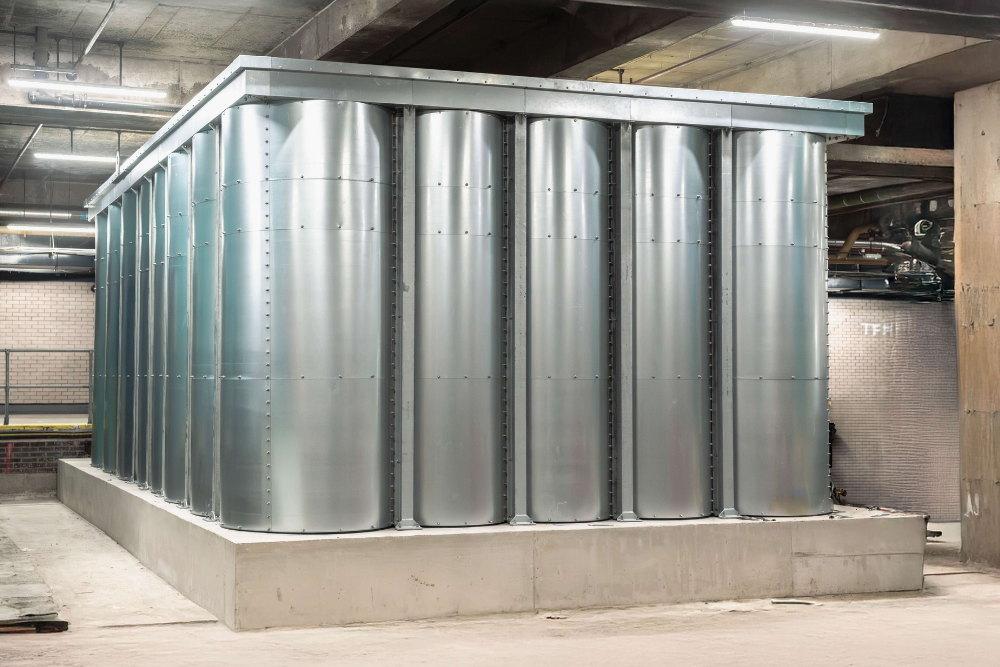
Sectional fire protection tanks are one of the most common applications for butyl and EPDM liners. Their bolted panel construction means the tank can be built to almost any shape, length or capacity on site, and the liner has to be manufactured to match.
Russetts Developments Ltd has supplied tank liners to Franklin Hodge across a wide range of fire protection projects over many years, including liners for their Firetainer® range. The Firetainer® is Franklin Hodge's sectional fire protection tank, built from bolted steel panels and designed so the finished tank can be configured to suit the site rather than the other way around. Because each Firetainer® takes its own dimensions, the liner inside it has to be specified, fabricated and fitted to that exact geometry. This is where the manufacturing detail above, the eyelet alignment, the protective geotextile bag, and the choice between butyl and EPDM, has a direct effect on how the finished tank performs.
Talk to Russetts Developments Ltd About Your Tank Liner Requirements
Specifying butyl or EPDM is rarely one-size-fits-all. What works for a sprinkler tank in a covered plantroom is unlikely to be the right answer for an exposed above-ground process tank, and the manufacturing detail behind the liner often matters as much as the rubber itself. With 40+ years of liner manufacturing across butyl, EPDM, SealEco rubber, and alternative materials, Contact us for specification guidance on your project.